


How to Use Cupping Therapy to Improve Your Health
- Melissa Robichaux

- Sep 11, 2023
- 3 min read
Where does cupping therapy come from?
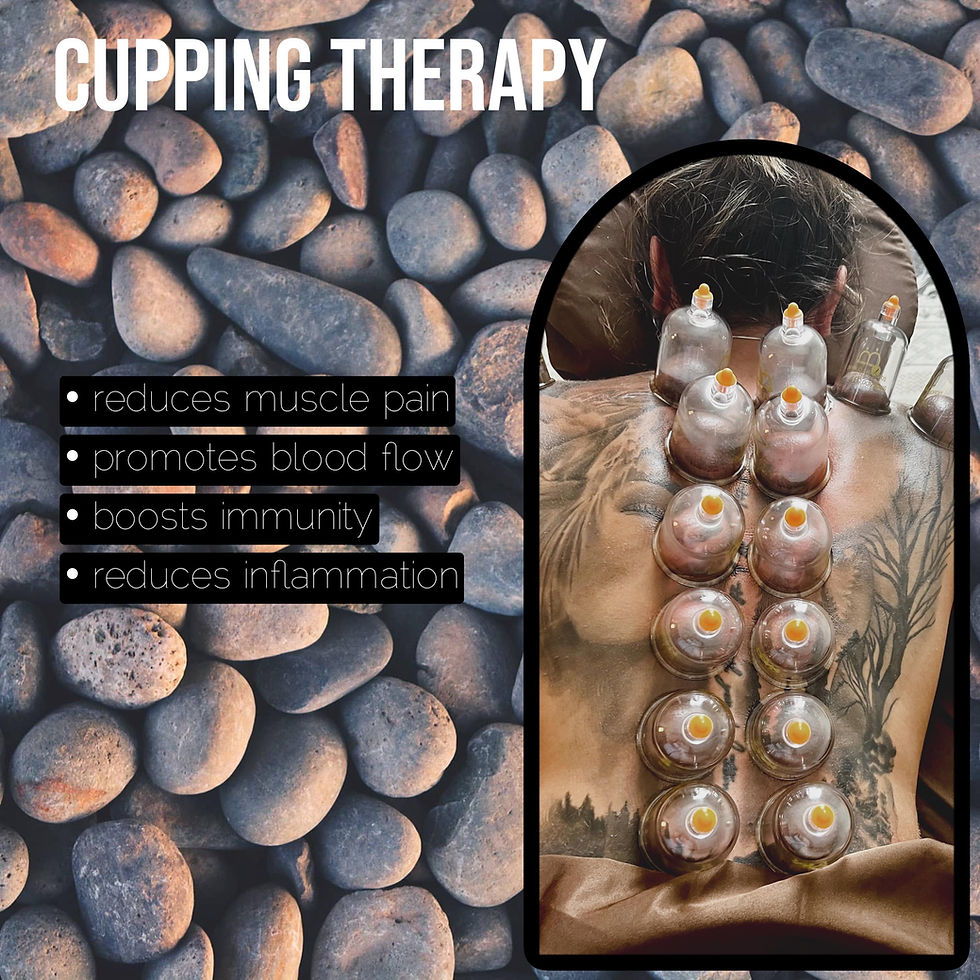
Cupping is just one of many ancient holistic modalities. Cupping is the method of either heating or suctioning glass cups onto the skin. When the cup is placed on your skin by either heat or air pump, your skin and muscle draw into the cup, causing you to feel intense pressure and sensation in that area.
Although the true origin of this practice is unknown, we can credit many cultures like Traditional Chinese Medicine (TCM) and ancient Egyptian practices. The practice of TCM focuses on whole-body health and rebalancing the body’s Qi, or vital life force of the body. Imbalances to the body’s Qi can cause illness or even disease.
Rooted in the concept that we are capable of self-healing, all the healing practices of Chinese Medicine circle back to the Five Element Theory. This theory “organizes all natural phenomena into five master groups or patterns in nature.” Each of the five groups—Wood, Fire, Earth, Metal, and Water—include categories such as a season, a direction, climate, stage of growth and development, internal organ, body tissue, emotion, aspect of the soul, taste, color, sound etc.
Traditional Chinese Medicine emphasizes the dynamic relationships we have with the external environment and our internal systems. To balance our Qi, we must address any potential imbalances inside the body and factor in any external elements.
How does cupping therapy promote health and wellness?
Even though cupping is an ancient practice, research evidence is still growing. According to a 2018 study, cupping is particularly effective for easing muscle soreness, aches, pain, and systematic diseases (diabetes mellitus, hypertension, and rheumatoid arthritis). Other effects include:
- Promotes the skins blood flow
- Changing the skin’s biomechanical properties
- Increasing pain thresholds
- Reducing inflammation
- Boosts cellular immunity
What to expect…
Today there are many different forms of cupping but one of the most common and accessible is dry cupping. Dry cupping does not require puncturing of the skin like wet cupping does. During the treatment you may feel lightheaded or dizzy. On rare occasions sweating and nausea may occur. After treatment you can expect to see circular marks where the cups have been and possible bruising. To avoid any discomfort, consult with your practitioner first. They may offer some remedies you can implement before your session.
My personal experience…
I did not see a Traditional Chinese Medicine doctor however I did verify the qualifications of my massage therapist who offered cupping therapy. I chose to add cupping therapy to my massage because, well why not! I’d always heard of the benefits of cupping but never thought it was that accessible.
When I was about halfway through my massage, the therapist placed 16 cups on my back and shoulders. The cups that were used had pumps on the top to increase and decrease suction. When the cups were first placed on, it felt very tight and itchy. After about 5 minutes, the itchiness subsided, and the tension started to feel less and less.
The cups stayed on for about 10 minutes. Now, let me tell you, that release of pressure felt amazing! I’d never felt anything like that before! The next few days my skin felt slightly sore where the cups were and I did have the red circular marks on my back for about a week or so, but they didn’t bother me. I also noticed how relaxed my back muscles were feeling for the next couple of weeks. After this experience, I would 10/10 do it again!
If you’re ever interested in trying cupping therapy, I recommend consulting with your practitioner first to ensure you are in good health for this type of therapy practice.
Have you tried this? Would you try this? Share in the comments!


It looks so cool i would most definitely give this a try 👏🏽